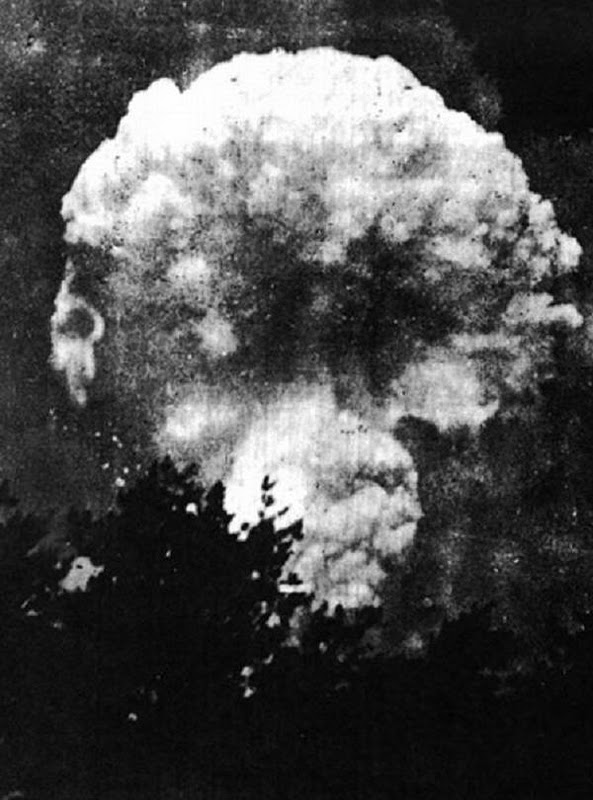
Today marks the 68th anniversary of the bombing of Hiroshima, and while I enjoy playing games about the devastation that comes after this sort of thing, it is sobering to be reminded of what that actually means.
PANORAMA. Photographed by Shigeo Hayashi from a watchtower of the Hiroshima Prefectural Commerce Association, October 5, 1945. Location: Moto-machi. Distance from hypocenter: approx. 260m.
The ruins of Hiroshima, as seen from the air, after the Japanese city was hit with an atomic bomb on August 6, 1945. The photo was taken a month later, in September 1945. Photo by Life/George Silk
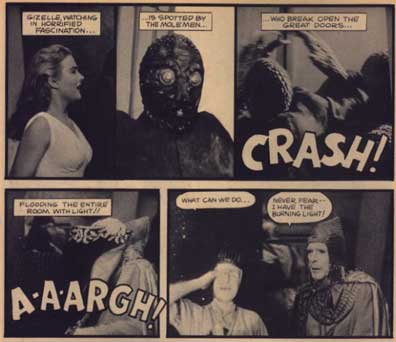
I've been thinking about fumetti lately, or rather photonovels. They've fallen out of favor lately, in all likelihood because of their association with pornography, but some of the old pulp fumettis were really great. I remember my father taking trips overseas when I was a kid, and bringing some home. I was fascinated by the merging of a comic book layout with B-Movie sensibility.
Recently, this has gotten me to thinking - has this sort of visual styling ever been applied to RPG modules? My recent trips into the wilderness have got me thinking that maybe it's possible? Certainly from a setting perspective, why not include a photo of a location that resembles the area that you're describing? While it's true that people look better in outfits that have been drawn than put on, it seems to me as though this could be done. With the capabilities that Photoshop brings, how hard is it to make your pictures fit the story you're trying to tell?
I may be crazy here, but it seems to me it could work? Maybe not on an ongoing basis, but at least as a one-off?
****Warning - If you Haven't played Bioshock, this post may contain spoilers which will severely inhibit your enjoyment of the game. Turn back if this sort of thing concerns you - YOU HAVE BEEN WARNED****
I'm a huge fan of Bioshock. I think it might be my favorite video game, no scratch that, I think it might be my favorite game period. In general, I don't play first person shooters. I find them dull and repetitive, and the idea of lining your sights up on a two pixel tall figure to try and kill it before it kills you just doesn't appeal to me. I heard good things about Bioshock, though. A horrific first person shooter with philosophical overtones? Well sign me up!
It did not disappoint.
It was horrific, it played with the ideas of Ayn Rand, it presented you with serious questions of ethics and morality. Oh yeah, and you blew stuff up. The thing that sealed the deal for me, though, was THAT PART. If you've played it, you know what I'm talking about, if you haven't, seriously, this is your last chance to turn back.
Okay. So when it turned out that you had been doing the bidding of the bad guy, not your character, but YOU YOURSELF. You, lulled into complacency by video game tropes, not even thinking about what the missions were accomplishing, were mind controlled just as much as your avatar by faceless being with a sunny sounding brogue and a, "Would you kindly..."
Mind. Blown.
Seriously, I put down the controller, and, all alone in my apartment, said out loud, "Damn. DAMN."
I can honestly say that is the only time that a game, video or otherwise, has had that kind of impact on me. So before I continue, hats off to 2K Games.
Now, to the point. I got to thinking, how to replicate that experience in an RPG? Specifically with regards to cursed items. Traditionally, in games that I've played, when somebody gets a cursed item, it usually goes something like, "Bad news, bro. That sword you picked up has a -1 modifier, and you can't ditch it until you find a priest."
Fair enough, that's accurate, but that's a player's description, and draws a bold line between the player and the character. Whenever I can, I'd rather blur that line, and force the player into the mindset of the character, so why not mess with the players a bit, rather than just the characters? Here are a couple that have come to mind.
Bloodthirsty Weapon
This one is a direct homage to Bioshock - the weapon appears, for all intents and purposes, to be a weapon of speed, allowing the user to strike first in combat. Who wouldn't want to use that weapon? It works fine, doing just what it says on the tin, until the party finds itself in a social setting, when the weapon leaps into the hand of the person who has been wielding it, and it strikes at the nearest noncombatant NPC. That's when you realize the weapon has been controlling you all along, not vice versa.
Weapon of Misdirection -1
This sword radiates strong magic, and the DM should tell the person wielding that it is a +3 weapon. Then, simply increase any foe's defense/AC/whatever by 4, without telling the player. If the player gets frustrated and tries to switch weapons, the DM secretly rolls a Wisdom check/saving throw/whatever. If it's failed, the character thinks they have switched weapons, while still holding the same cursed weapon. If they pass the check, they realize the weapon is cursed.
Deck of Many Curses
See who the degenerate gamblers in your group are. It's a Deck of Many Things, with all the good stuff taken out. With unlimited draws.
Ring of Inner Truth
Ring of +1 Wisdom, but at the GM's discretion, table talk is actually spoken aloud by the character.
Tent of Paranoia
This tent aids in the healing of the characters, and is big enough for the entire party. Any who sleep within it double their normal healing. For the following 24 hours, however, all NPCs appear to be monsters or other demonic creatures. Any speech will be heard as threatening, and movements observed will promise violence. The illusion persists until they are dead, at which point their true form is revealed. Actual monsters and other demonic creatures appear and act as normal.
The point is, you're the GM - nothing says that you have to be a reliable narrator! It's something gamers tend to take for granted, but it doesn't have to be that way - keep them on their toes and make them question everything!
My wife and I finally finished our epic road trip late Saturday night, and spent all day Sunday doing pretty much nothing. We're watching Babylon 5 for the first time, so most of the day was spent working through Season 2.
Before we left, we generated a massive, 1200 song playlist on Spotify to accompany us on the road as we traveled. I've already described one instance where the music synchronized with our experiences, but it happened again late Saturday.
We pulled through Oklahoma City after dark, and set off down the road towards Dallas, and as we rode, Johnny Cash's turn came up on the playlist, and he sang us through the night. Ghost Riders In the Sky set my mind racing as we drove through the black plains, the tale of damned cowboys forever chasing the Devil's Herd calling to mind the tales of the Wild Hunt.
For a brief bit of time, I was free. The window was rolled down, the air was sweet and the world seemed like it went on forever, that there was nothing to hold me back, nothing to keep me from doing anything I could imagine. Ideas popped and snapped in my head like fireworks, and I could see it all.
And then... and then... the lights of Dallas started to appear in the sky. The darkness was pushed back, and I started seeing the overpasses and the buildings and the cars and the construction. It turned out my playlist had one final joke to play, one last bit of irony to share...
That isn't my favorite recording, I think the guitar line in the middle betrays the solemnity of the song, but hopefully you get the point. Honestly, though, hopefully you don't.
So I've been doing a lot of writing lately, and I don't know about you, but I needs me some music to go along with any creative efforts, so I figured I'd share some of the music that gets my creative juices flowing.
In general, I need music that is... open. The "busier" the music, the less room I have for my own thoughts.
That means a lot of classical music, and a lot of ambient music, so if these things are not your cup of tea, abandon hope, ye who enter here.
Adagios in general are nice to create to. Nice and slow, easy does it. This recording in particular is a favorite of mine, Karajan was an incredible conductor, and brought out the feeling in many recordings. Apropos of nothing, if he hadn't been dead, I totally would have lobbied for him to play Gandalf, btw.
Speaking of adagios, if you haven't heard this one, under what rock have you been living? Barber's Adagio is hands down one of the most beautiful pieces of music ever set to paper, and nobody captured the essence like Leonard Bernstein and the New York Philharmonic. You may know the song, but if you haven't heard this recording, you haven't heard it like it should be done.
From what I understand, Thomas Tallis is undergoing a renaissance of sorts, thanks to, of all things, Fifty Shades of Gray.
Sigh.
Even a stopped clock is right twice a day, I suppose. Tallis was doing the wall of sound thing 500 years ago, and the music reminds me of the ocean, shifting and sliding, while still being one, cohesive "thing".
Everyone knows the fourth movement of Dvorak's New World Symphony - the opening sounds like Jaws, then goes all brassy and badass. The second movement, though, is mellow, and just a bit threatening, if you know what's coming. You can feel the momentum building as you go along, while still getting a sense of stillness and peace.
Now we go to some darker places:
For some reason, Spotify lists the song above as Powler, it's actually called Prowler. It's by one of the greatest bands to ever have a ridiculously stupid name, Bohren and Der Club of Gore. They started out as a fairly generic death metal band, and then got interesting, introducing the world to the concept of Doom Jazz. It's music for the streets of a dark city, where the bar just closed and boozy patrons are slinking into the shadows, as a lone sax player stands beneath the streetlight, his music mournfully accompanying them to the grasping darkness that awaits them...
Philip Glass, oh Philip Glass. Candyman was terrifying enough as it was, why did you have to go and make it worse? It's not often that the music of a film encapsulates the entirety of the film as neatly as this does - haunting and beautify, simple and repetitive, it stays with you long after the film itself. As long as I'm on the topic, though, next time you watch Candyman, watch it with the idea that Helen has gone ridiculously insane and is an unreliable narrator - It was always you, Helen, takes on a very different meaning. Anyways, Philip Glass - the Candyman soundtrack is a good point of entry for anyone interested in the idea of voice as a musical instrument.
Brian Williams, aka Lustmord is the king of Dark Ambient. Pretty much any of his works do the trick, but The Place Where the Black Stars Hang one is a particular favorite of mine. If you get a chance to see him perform, you owe it to yourself to do so. His performances are wonderful and amazing and terrifying and beyond real description, just like the music itself. The album is over an hour long, and the video above has it all one small part of it. Put on some good earphones, turn down the lights, and start writing.
Peter Andersson is a prolific dark ambient musician, with numerous projects. I could make an entire post just about his various projects - each approaches the idea of dark ambiance from different perspectives. Raison d'etre is his most well known, and approaches from an industrial angle, while Necrophorus focuses more on naturalistic ambiance Panzar is.... terrifying. The album this track is from, Human Degeneration, is, so far as I can tell, some sort of concept album about the Holocaust, or WWII in general (lots of talking in German, which I don't understand - for all I know it could be a recipe for cookies), and it is every bit as haunting, ominous and threatening as you would imagine such an album would be. To feel the full effect, you should listen to the entire album which can be heard here. This track, though, captures most of it.
Enough of the dark stuff, here are some lighter works.
Steve Reich is a pioneering minimalist, and this shows the power of his work. In this work, he takes a simple phrase, and turns it into an audio feast that will blast anything that is stuck in your head into oblivion. A good audio enema.
I recently had an opportunity to see Robert Rich perform live. He did a house tour of the world, putting on concerts literally in peoples' homes. I was one of about 25 people at the concert, my better half and I lounging on a couch. At some point my eyes closed, I was drifting, aware, but at peace. The music ended and my eyes opened and I was refreshed. It's that kind of music.
The phrase, "Because f**k you, that's why" has become quite popular recently to explain all sorts of shortcomings in media, both written and visual. It gets used because of times when it appears as though a writer is lazy, or because an editor has cut something that is a bit more essential than they thought.
What this tends to make us forget, though, is that not everything needs to be explained. Sometimes, not explaining just makes things better. I remember my first time picking up an X-Men comic, back in 1986. It was Uncanny X-Men #209. On the cover, Nimrod and Colossus were grappling with each other, and in the inside, people died. Some ended up coming back, some stayed dead, and mostly I had only vague ideas of who most of them were. There were hints dropped at things that had happened previously, and more hints regarding things to come, but it didn't feel as though it was an incomplete story. Rather than being turned off by the existence of more to the story, it drove me back to the store, first to get back issues, then to keep going, keep following the story.
Obviously, that's harder to do in a movie than in a comic book. It'll be a whole lot harder to bring me back to a Prometheus sequel, for instance, because as pretty as it looked, they strung me along for two hours, asking questions which they did not end up answering.
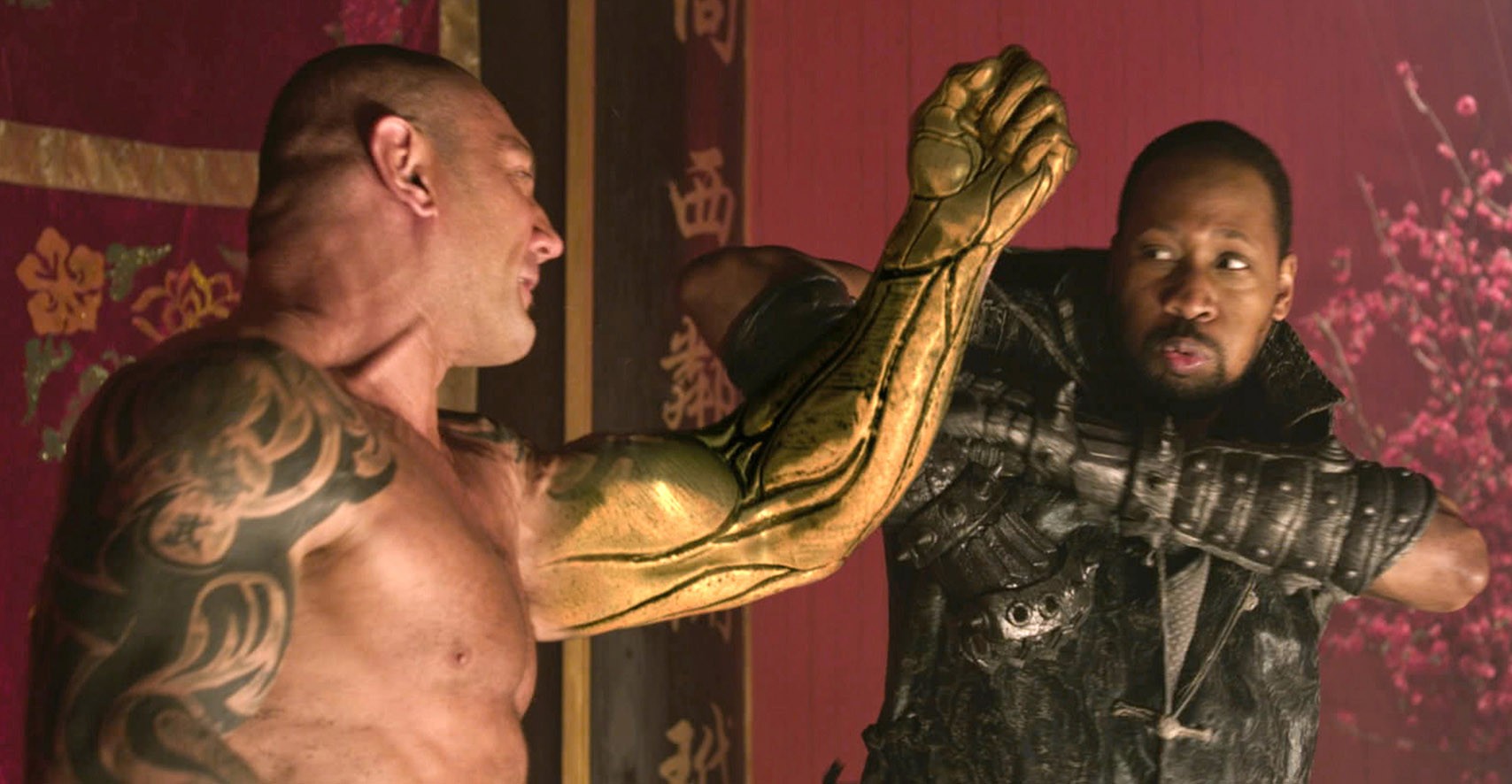
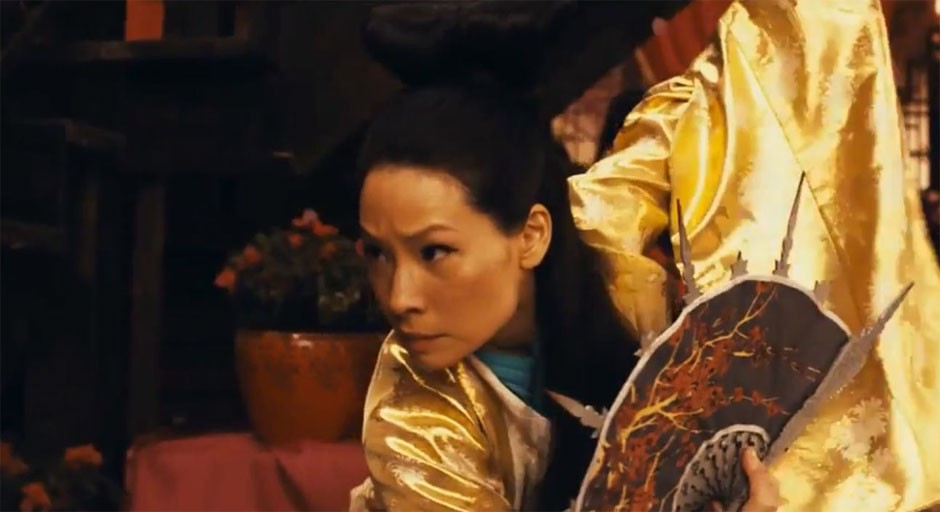
Which brings me to The Man With the Iron Fists. On the one hand, you can see some similarities to Prometheus. The story is that the RZA's original cut of this movie clocked in at over four hours, while the final cut is barely over an hour and a half so you know there's a lot left on the cutting room floor, and I honestly hope that at some point there is a Director's Cut released filling in as much of that as possible.
What was left, though, was a movie that functions much like Chris Claremont's issue of Uncanny X-Men. There is obviously more to this story than what is presented in the film. The difference between this and Prometheus is that MWtIF asks no questions, it simply exists. Would I love to know how/why Brass Body can turn his body into brass? Sure I would! But see, here's the thing - I'm a big fan of the TV Tropes website, and I came across a page there recently called the Rule of Cool. The idea is simply this - the limit of the Willing Suspension of Disbelief for a given element is directly proportional to the element's awesomeness. So while I would like to know about Brass Body's backstory, I'm content to see him kicking ass on the screen. All of this got me thinking about RPGs. First of all, somebody should get the RZA to make an RPG. The amount of world building that went into that film was phenomenal, which also helped it out when it came to the issues described above. It didn't feel as though we were getting less than a whole movie, so much as we were peeking through the View Finder into a realistic, fully fleshed world filled with people who existed before the movie and would continue on after.
More to the point though, we get tied down in the hows and whys of things very often. We want things to be "realistic". We want things to make sense. And yes, to a certain extent this should be true. There should be an internal consistency to things - I was perfectly satisfied with Russel Crow having a knife that spun around and also fired bullets. I would have been less so had he pulled out a plasma rifle and started launching neutron grenades at his enemies. But I don't need the answer to every single question, unless the movie explicitly asks them. Another good example of this is in the Wire. If you haven't seen it, shame on you, go and find it and watch it. There is a character in the show, I won't spoil who on the off chance that there are people who still haven't seen it, who is presented as an antagonist throughout the show. In the last season, as a character is leaving a gay bar, in the background of a single shot, there and gone so quick you'd be forgiven for missing it, is this character. Not once in the entire series is it mentioned that he's gay, it plays absolutely no role in developing any of the many plots in the series, it's just an, "Oh, by the way..." sort of moment. My point is, it's those sorts of moments that make a series more "realistic". Not answers, but statements that generate questions, that let you fill in the blanks. The moments that spawn discussion around the table after too many drinks - who'd win in a fight, Superman or Batman? What happened to all the other people on the wheel in Conan? Rather than frustrate the veiwer, they invite them to fill in the blanks themselves, letting them "own" the story in a small way.
WE NEED MORE OF THAT IN OUR RPGs! It doesn't have to be, "Because f**k you, tha's why!", but rather, "Because it's awesome, THATs why!" Not everything needs to be explained. We don't need a rule for every conceivable action that a character might take. We don't even need rules for every likely action. We don't need every spider and caterpillar codified with stats and XP awards listed in the modules. We don't need megadungeons, or sandboxes or hexcrawls. What we need is balls to the wall enthusiasm. What we need is world building. What we need are players who want to peek throug the View Finder to share in a world of someone else's creation who are willing to help breathe life into that world and watch it grow and evolve as they go. We need players who ask questions rather than demand answers, who look for reasons why instead of why not. We need GMs who are willing to be flexible, and willing to find a balance between fun and realism. We need level-set expectations from all parties, but the freedom to exceed them, and the willing to figure out how to make things work even when they miss. Or maybe it's just what I need.
This was a tough one to write. What can you really say about John Carpenter's movies? You either love them or you hate them. If you love them, you know everything I'm about to say. If you hate them, me saying that I love them and why probably won't change your mind. Here goes nothing...
It's important, I think, to remember that Carpenter at his best is an auteur - some of his best and most fondly remembered films are instances where he exerted his influence on multiple levels. At various points he has written, directed, produced, acted in and composed music for his movies. Say what you will about his films, but very often they have a strong "voice" that carries throughout the work. There is a list here that breaks down his entire filmography based on his contributions to each work. Follow the link and be amazed!
Rather than try and list every single one of his works, I'm going to cherry pick what I feel to be some of his best. I'll include at the end the extent of his involvement.
Halloween: Well duh. The movie that launched an entire generation of slasher films, that defined Jamie Lee Curtis' career, that established Carpenter as force to be reckoned with in horror films, that bought Michael Meyers permanent real estate in the zeitgeist. The story of how the movie of made is almost as interesting as the movie itself, and is worth a read, or a watch of any of the dozens of documentaries on the making of the movie. Carpenter controlled every aspect of this film, Directing, Writing, Producing, creating the Music for it, and even put himself into it (he provides the voice for Annie's boyfriend). This is how you make a low budget movie. Scratch that, this is how you make a GOOD low budget movie.
The Fog: The 1980 version, naturally, the less said of the remake the better. I'm not a huge fan of ghost story movies, but that's mostly because this one did it so damn well. Jamie Lee Curtis and Adrienne Barbeau lead the way, in this tale of a town's dark secret as it comes back to haunt them on the anniversary of the town's founding. It's the story Stephen King wishes he wrote. He directed, wrote, composed music for and acted in the film (playing the role of Bennett).
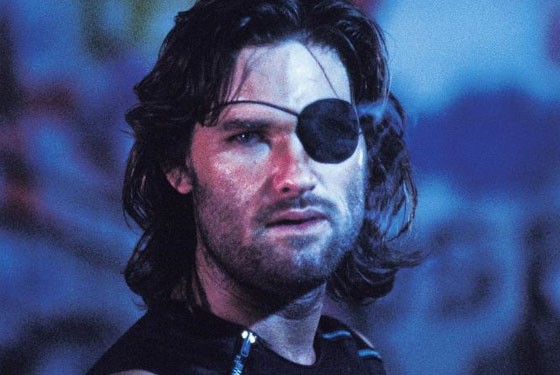
Escape From New York: Every once in awhile I run into someone who has never seen this movie, and it blows my mind every time. I mean... Snake Plisskin - c'mon! The second teamup between Kurt Russell and Carpenter (5 internets to anyone who knows what the first one is without googling it), and Russell proves why he's an action star for the ages. Come to think of it, I hope he can at least make a cameo in the next Expendables. I think he's about the only one left who hasn't. But yeah, Escape From New York, Russell is a badass, it's postapocalyptic, it's got Isaac Hayes as the friggin Duke on New York City, Donald Pleasance as the President of the USA, how have people not seen this????? I
It should be required viewing, 'sall I'm saying.
The Thing: I was a fan of the original. I love the original. I have memories of watching the original through my fingers as a kid.
I like Carpenter's version better.
It takes the basic plot of the original and spins it into a tale of paranoia, isolation and fear and you just can't look away. Another Kurt Russell film, he continues to show why he's a badass mofo. Interestingly, Carpenter considers this, In the Mouth of Madness and Prince of Darkness to be a sort of Apocalypse Trilogy, all of which share a common theme of cosmic horror. He was only the director on this one, although he did have a bit part as one of the Norwegians in the video.
Body Bags: Remember this one? The made for TV movie?
I forgive you for saying no. It wasn't his best outing, but it has a special place in my heart, reminding me as it does of the old Amicus films from way back when. Carpenter teams up with Tobe Hooper to bring you three tales of comedic horror, with varying results. The first one is the best (incidentally, it takes place in Haddonfield, IL, the same town that Halloween was based in), telling about a girl locked in a gas station when a killer is on the loose. The second is just batshit crazy, with Stacey Keach, aliens and... hair. The third, well, the third just kind of exists. Overall, it's not that great, but it's fun, and I enjoy it, so whatever. He did Direct, Produce and Compose music for it.
Masters of Horror: Cigarette Burns: Technically not a movie, but it was his best output in years, so it needs to be mentioned (which, incidentally, made his followup on the same show so disappointing). Tapped to direct an episode of Showtime's Masters of Horror, the title refers to the practice of film cues, meant to tell the projectionist that the reel is coming to an end. This ties in thematically with the larger story (starring everyone's favorite survivor, Norman Reedus) as he searches for a film that supposedly drives the viewer mad. It's a spiritual sequel to In the Mouth of Madness, another of my favorites, and, I suspect, an unofficial member of Carpenter's Apocalypse series.
Pontypool - Or rather, Noam Chomsky's Dawn of the Dead. Just when you think there's nothing left to be done with the Zombie Movie genre, a gem like this one comes along and surprises you. Seriously, the vector for infection is unlike anything I've seen in movies or literature, and actually kept me interested. The setting is claustrophobic, the acting is superb, and it's developed in such a manner that keeps you involved until the bitter end.
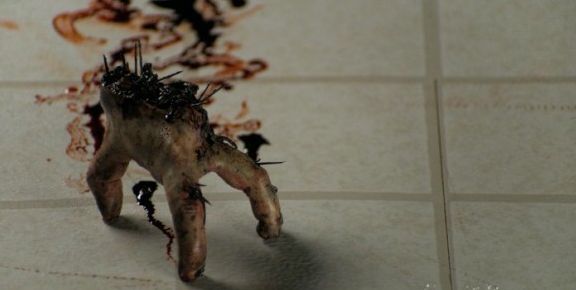
Splinter - I don't think I can overstate how low my expectations were for this film, so that probably helped cement it as a favorite when it actually turned out to be good. Even with that caveat, I think most would agree this was a fantastic horror film. It has what you want - an original villain, special effects that are horrific, but well (and selectively) used to maximize impact, decent acting and a great ending. I went into this expecting a SyFy Original Movie, and got something else entirely. The setup is basic - two couples have an unfortunate chance encounter and are trapped inside a remote gas station - it's the execution that matters. It got nominated for a slew of awards when it came out, but lost to bigger budgeted movies, even though (IMHO), this movie used its money far more wisely and effectively than any of their competitors (which included Saw and Hellboy II).
AM1200 - "Lovecraftian" is a term that gets tossed around quite a bit in the reviews of this short film, and not undeservedly so. At 40 minutes, this is less of a film than it is a visual business card for first time (non-documentary) director David Prior. With so little time, there's no need for filler, it gets straight to the point and never lets up, cranking up the tension. After stealing a bunch of money from his employer, the protagonist goes on the lam, jumping into his car and heading off cross country to escape. He tunes into the titular radio station as he goes, which preaches an evangelical message at first before morphing into a cry for help. Continuing his streak of bad ideas, the protagonist decides to track down the station and try and help out. Anything more would spoil this one, so if you haven't seen it, find it. The DVD is for sale on the movie's website, by the way.
End of the Line - I was rolling my eyes at parts of this, but stuck with it till the end, and I'm glad that I did. What at first appear to be rather hamfisted swipes at modern religion actually serve a purpose, setting the viewer up for the ending of the movie, which is both horrific and unexpected. The upshot is that a cult decides that the end of the world is nigh, and go about "saving souls" using sharp pointy objects. Some folks are trapped in the subway with some cultists, and drama ensues. The acting leaves a bit to be desired, but can be forgiven. Watching it for a second time means wading through the eye-rolling again, and I think the payoff only works once. So I'm not sure how much replay value this movie has, but if you haven't seen it before, it's worth it, at least once.
Frailty - Speaking of eye-rolling religious symbolism that ends up being better than expected, there's Bill Paxton's directorial debut. Maybe it's his terrifying earnestness, maybe it's the better than average performances by the kids, but whatever it is, this movie works. Paxton comes home one day to tell his children that God has told him that there are demons hidden inside some people, and that it's his job to "destroy" them, and he really loves his boys and wants them to be a part of his vocation. There's a bookending piece to this that provides a nice twist, but it's not really needed - the core story is riveting enough.
House (Hausu) - I try and avoid spoilers in these reviews, mostly because I don't want someone to lose some of the impact of the movie by knowing what they're getting into. Imagine seeing Dark City for the first time, and knowing that.... what happens... happens ahead of time? It's still a good movie, but it looses some of the punch. In this case, I'm not revealing anything because it wouldn't make any sense anyways. There's really no way to explain this movie without the shared context that comes from having seen it. Filmed in 1977 but only released in North America several years ago, I can almost guarantee that you will utter the some iteration of the words, "What the hell?" at least once during this movie. I wasn't even sure whether or not to include it in the list because I'm not sure how much of a horror movie it's supposed to be. While it uses many of the tropes of horror movies, it has characters with names like Gorgeous, Fantasy, Prof and Kung Fu, and that's the least of the weirdness. Upshot is, you're never sure exactly how seriously you should be taking this. Definitely worth the watch, just to say that you have.
I love October. I really do. The weather starts to cool down, the trees start to change color, lots of work holidays are coming up which means more family time, and best of all, I have an excuse to watch horror movies that my wife would otherwise veto.
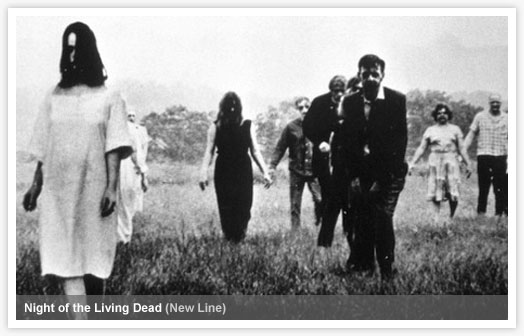
I've recently been out to the theater to see two, one that was very good, the other that wasn't horrible, and Paranormal Activity 4 kicks off today, so far so good. I'll get to them in Part II, but for Part I, I wanted to show some love for my very favorite horror movies of all time. I'll try and avoid the obvious ones (Night of the Living Dead, Psycho, Exorcist, Halloween, etc), in hopes that there might be at least one on the list you've never seen before....
Maybe?
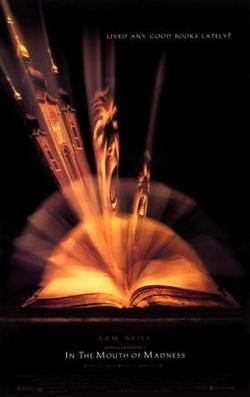
In the Mouth of Madness: I'm a big fan of John Carpenter. His recent stuff has been pretty ho-hum, but when the man was in his prime, he could crank out stories that would chill you to the bone. I don't want this to be a post devoted entirely to John Carpenter (maybe later this month), so I picked my favorite, and that was tough. In the Mouth of Madness, though, sits at the top of my list. The inimitable Sam Neill in all his Sam Neill-ishness, the obvious Lovecraftian overtones, the genuinelydisturbinguseof specialeffects, but more importantly the wisdom of knowing when NOT to use them. It's rare to encounter a movie in the modern age that has any sense of restraint - why hint at death and destruction when we can throw it in the viewers' faces? I don't know about you, but the things I imagine typically scare me more than the best Hollywood shlock, and Carpenter gets that.
Crazy fact about the movie: the Black Church depicted in the film as the seat of all evil is a real place!
The Medusa Touch: A latter day Richard Burton glowers and growls his way through this tale of a man with a "gift for disaster", proving that misanthropy and psychic abilities are a bad combination. There is a scene in this movie, you'll know it when you see it, that explains why this gem has never been released in the States. There's not too much to say about this - it's got spectacular acting, a solid plot, some shocking scenes that make this a regular every Halloween. Burton's dead-fish stare make his dialogue all the more terrifying, and there's a general air of creepy, "things are not right" that runs through the background of the entire film, which leads up to a horrific climax that makes you want to start the movie over again to catch all the things you missed the first time through.
The Sentinel: This movie is a veritable Who's Who of actors, including some from before they were famous. Jerry Orbach, Christopher Walken, Jeff Goldblum, Tom Berenger, Burgess Meredith, Chris Sarandon, John Carradine, Arthur Kennedy, Ava Gardner, Martin Balsam, Jose Ferrer and Eli Wallach all share the stage in the 1977 film. In it, an actress moves into a loft in NYC, at a price that seems to be too good to be true. Of course, it is too good to be true - the building sits on a gate to hell, and the order of excommunicated priests that own it have their sights set on the heroine to become the next guardian of the portal.
The movie does an outstanding job of starting things off with an uneasy feeling, then ratcheting up the tension to a truly terrifying finale, made infamous by the fact that actual physically and mentally disabled people were hired to portray demons and damned souls. Whether it was in good taste or not, it makes for a scene you won't forget.
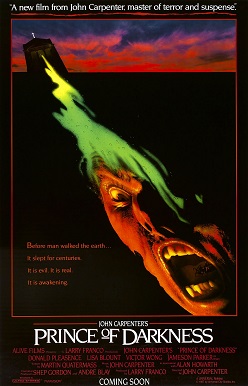
Prince of Darkness: Okay, so I said I would only put one John Carpenter movie on this list, but I'd be remiss if I didn't include at least one more. This movie often gets a bad rap, and not entirely undeservedly so. Alice Cooper plays a hobo that stabs someone with a bicycle, and the portrayal of the villain is not what most people are expecting. Fair enough. But the good outweighs the bad by far. In a recent g+ thread, Raggi asked who the audience thought should write a LotFP adventure, and I threw Carpenter's name up there with this movie in mind. It's a classic RPG setup - a group of scientists from disparate fields are called to a church basement by an order of priests who, as it turns out, have been hiding the Anti-Christ from prying eyes for centuries. Unfortunately for them, and the rest of the planet, it appears to be waking up. They are trapped in the church, and the fight for survival begins. It's a metaphysical, eschatological horror story with a foundation in Carpenter's studies of theoretical physics and atomic theory. What's not to love??????
"I have a message for you, and you're not going to like it. Pray for death."
shudder.
Session 9: Starring David Caruso, this was Brad Anderson's first horror movie, but he did it right. I could have sworn Chris Bauer was also in this, but IMDB says I'm wrong. Huh. Anyhow, this is a movie that is all about atmosphere. An asbestos crew goes into an abandoned asylum, and things start to get weird. Then they get weirder, and weirder still. Nobody went to see it when it was released, which is a shame, because it's almost universally praised. It's a movie that plays with the viewer's expectations, and pulls off an ending that would have fizzled in lesser hands. I'd love to tell more about it, but I don't want to take away from the awesomeness that comes from seeing this cold. Just trust me and watch it.
It's also the origin of this classic .gif file, from the ever-over-emotive David Caruso:
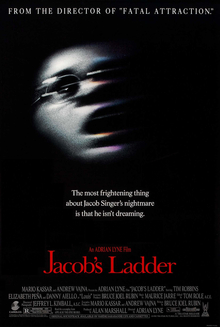
Jacob's Ladder: Another movie that excels at barely glancing at the more horrific aspects of its mythology rather than slapping the viewer across the face with them, freakishly tall Tim Robbins (6'5!) plays a Vietnam vet who comes home from the war after nearly losing his life to find that things are significantly stranger than he remembers them being. Another movie that watches like an RPG, you can see the influence on 90s horror RPGs such as Kult, World of Darkness, and other games where the horror of the unknown creeps in, fraying the edges of the world a bit at a time until the protagonist can't tell where the real world ends and where the horror begins. A movie that keeps the viewer off balance, and effectively puts the viewer in the protagonist's seat, you'll find yourself wondering along with Robbins' character, "Did I really just see that?"
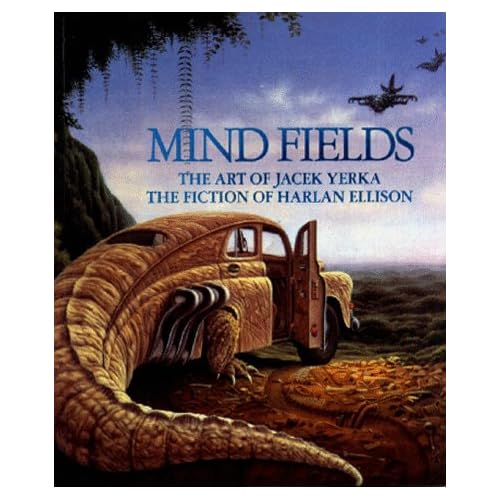
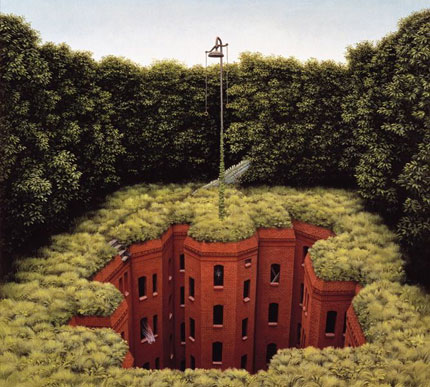
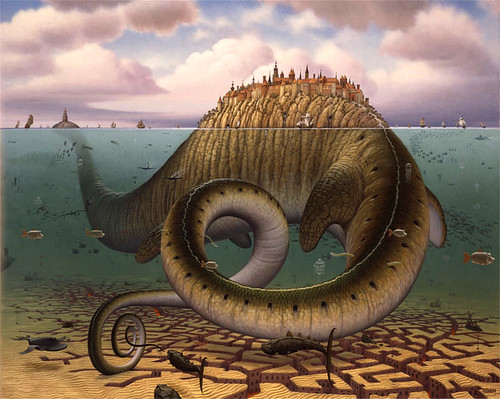
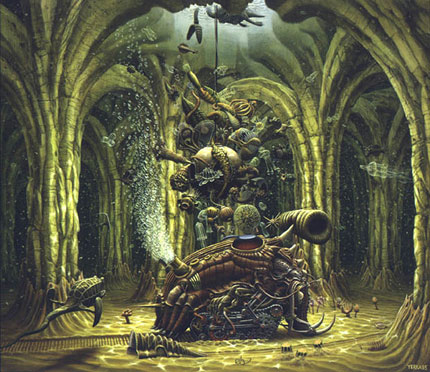
In the comments of yesterday's post, I was reminded of Mind Fields, a book of art by Jacek Yerka, with original fiction penned by the estimable Harlan Ellison. I don't remember how I got this book, I think it was a gift maybe. Apparently, Ellison was initially approached by the publishers and asked to write an introduction to the book, but, in typical Ellison fashion, loved the art so much that he asked if he could write a separate piece of fiction for each painting. While some of the stories are directly inspired by the subject matter of the painting it accompanies, others have a more oblique relationship, dealing with the themes that Ellison saw in Yerka's work. If you're a fan of Ellison's work, seek this book out, it's well worth your time, solely from a fictional perspective.
As much as I love his work, though, the pictures below don't really do them justice - Yerka's genius is in the details, the little things that you find when you see them on a page that you can pull close to your face - he's an artist that rewards close inspection.
If you're not a fan of Ellison's work, go find another book of Yerka's art, I can't recommend him enough.
Good pedigree there, and it shows in his works, which boggle the mind and spur my imagination every time I see them.
Over on Rather Gamey, Ark was describing an adventure format for Stars Without Number, based on the idea that you're all "Redshirts", beamed in and out of planets, which would allow for quick, one shot adventures with a rotating cast. In the comments, someone pointed out that if the adventure didn't wrap up at the end of one session and instead needed to carry over to the next, each person would have to show up next time, defeating the modular aspect that Ark was going for. Instead, he suggested, why not have a crazy computer AI beaming people in and out of scenarios at random intervals, so if someone drops out mid session, oh don't worry it's just that glitchy AI, it must have changed it's mind, Ensign Singh is gone now, and oh it looks like he's been replaced by Yeoman Hossenfeffer.
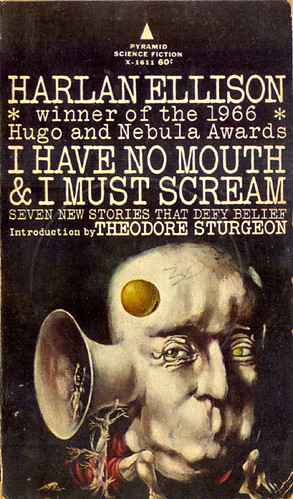
Now, to me, that sounds like you've left Gene Roddenberry behind, and crossed over into Harlan Ellison, specificially one of my favorite short stories of all time, "I Have No Mouth and I Must Scream". What an awesome game that would be. The story practically writes its own RPG - the AI = GM, you've got different characters, each with their own specialty (even if one of those specialties is f***ing), and they're being led through an endless maze by a crazed AI who just wants to mess with them. Now that I think about it, you could probably file the serial numbers off of Paranoia and run it pretty well.
Or you could just make your own game, because hey, Harlan wouldn't care if someone made a game based on his idea, right? Right?
Hahaha of course he would.
Maybe a free version just distributed via fileshare, adapting the book to another system, a la Thundarr for Mutant Future? I dunno, I'm not sure how that would work, but I'm curious enough to find out!
Thinking about this has inspired me to crack open some of my Ellison books, and I may post more about him in the near future, as he's been a huge inspiration to me since I was but a lad. I've written about half of a novel that is a love letter and spiritual sequel to The Whimper of Whipped Dogs, and Deathbird Stories is one of my favorite books, 25 years after I read it for the first time. As much of a cranky, quixotic bastard as Ellison can be, his stories always manage to evoke a reaction in me, and he'll always be at the top of my list of authors.
**WARNING** This post will likely be a stream of consciousness style ramble, feel free to disregard.
Still here? Okay, you were warned.
Back to the grind after a ridiculous week, capped over the weekend with front and center tickets to see Dead Can Dance. This was followed by my bachelor party the following evening, a night of epic debauchery of which the less said the better.
Still, time marches ever on, and my nine to five awaits, beckoning with a crook of its boney finger. I have no choice but to obey.
After seeing an ad stating that a (somewhat) local game shop had closed down, I briefly toyed with the idea of buying it. They were offering the building for 70,000 and their stock for another 50,000, giving the prospective buyer (presumably) a turnkey business for only 120,000. My better half and I took a detour on our way back from the weekend, and discovered there were two very good reasons why the shop went out of business - a) they didn't have insurance on the building, so when their roof leaked, they were unable to afford to fix it, b) they opened the shop in the middle of frikkin nowhere, in a town of maybe 25,000 people. So we're still possibly considering picking up the merchandise and opening a web store. Maybe. Dunno.
Work on the Clockwork Cave was halted for the weekend, but resumes today. Doug Kovacs is working on a few other projects, so in all likelihood, this won't see the light of day until the new year at the earliest. Probably later.
In Kickstarter news, I received my copy of Shadows of Esteren, a French RPG which was recently Kickstarted into English. I was primarily attracted to the production values, which seemed high, and they delivered. I'll post a review in the next few days that breaks down the rewards completely, but I was defninitely satisfied with how it came out.
While browsing through a Half Price Books in Austin, I stumbled across a little gem, Unhallowed Metropolis, which describes itself as, "The Gas-Mask Chic Role-playing Game of Neo-Victorian Horror". Now setting aside the fact that I wasn't aware that the words Gas-Mask and Chic could be combined in such a way, it's an interesting book. They saved a few farthings by using photographs instead of art a fair amount of time, with varying amounts of success. Some of them looked excellent, while others looked like glorified cosplay. Definitely worth the half price I paid for it, I'll be mining it for ideas.
I think I've run out of things to talk about at this point, so I'll be signing off.
Based on what I've seen around the blogosphere, RPG bloggers will make up the majority of the population of mankind after the first year of the zombie apocalypse. I think that, rather than sharing a badge, it would be more interesting to share the answers that got us all these high scores. I, for one, would like to know who the people are that are going to shut the door on people, or not go across town to check on loved ones. Stuff like that is good to know.
As I'm staring at the title of this post, I'm reminded of the excellent Charlie Brooker series Dead Set. It takes what, on it's surface, is a patently absurd idea - a zombie outbreak occurs, trapping the contestants of Big Brother inside the Big Brother House, and plays it perfectly straight. Brooker uses the situation, in the tradition of the genre, to comment on society at large, and does so wonderfully, creating a tale that is humourous, pointed, and horrifying at various points. Check it out. And really, check out anything Charlie Brooker does, he's a cynical, shouty version of Jon Stewart, minus Stewart's self congratulatory smarminess.



















.jpg)